Trimix injections: what they are and how they work
What Trimix is, how the three drugs work together, how well injection therapy actually works, what the risks are in numbers, and why most men who stop do so in the first two months.
- Updated
- Reading time
- 13 min read
- Written by
- Caesar Editorial Team
- Published

The short answer
Trimix is a combination of three drugs, alprostadil, papaverine and phentolamine, mixed by a compounding pharmacy and injected into the shaft of the penis to produce an erection. It is used mainly by men for whom oral tablets like sildenafil or tadalafil have stopped working, or never worked well. It is not a manufactured product and not FDA-approved. It exists only through compounding.
If that is all you came for, that is the whole of it. The rest of this page covers how the three drugs work together, where injections sit among the options, what the evidence shows about how well they work, what the risks are in numbers, and why so many men who start eventually stop.
What Trimix is
Three drugs in one solution:
- Alprostadil, a synthetic analogue of prostaglandin E1.
- Papaverine hydrochloride, a smooth-muscle relaxant.
- Phentolamine mesylate, an alpha-adrenergic blocker.
A commonly described compounding formula runs papaverine 30 mg, phentolamine 1 to 2 mg and alprostadil 20 µg/mL. (StatPearls: Alprostadil) That is a formula rather than the formula, and the distinction matters more than it sounds: concentrations vary between pharmacies, which is why dosing does not transfer between vials and why published stability figures do not transfer either.
"Compounded" is a regulatory category, not a quality grade, and it is worth being precise because the word does a lot of unearned work in marketing copy.
Under section 503A of the Food, Drug and Cosmetic Act, a compounded preparation is made against a prescription for an individual patient, and is exempt from pre-market approval, from current good manufacturing practice requirements, and from labelling with adequate directions for use. A 503B outsourcing facility operates differently: it may compound without patient-specific prescriptions, it is subject to CGMP, and it is inspected by the FDA on a risk-based schedule. (FDA: Human Drug Compounding Laws)
Neither route is FDA approval. In the agency's own words: "Compounded drugs are not reviewed by the agency for safety, effectiveness or quality prior to marketing." (FDA: what to know when promoting compounded drugs)
That is the accurate frame and this page will keep it. A compounded preparation is not an approved drug, not a version of one, and not evaluated the way an approved drug is. What it is, is a preparation made to a prescription by a licensed pharmacy, which is a real thing with real oversight and a different thing from approval.
How it works, and why three drugs rather than one
Start with the practical payoff, because it answers the question most men are actually asking.
Alprostadil dose is the main driver of injection pain. Combining it with two drugs that work by different routes lets the same erectile effect be reached at a lower alprostadil dose. As the StatPearls reference puts it, Trimix "significantly reduces the required alprostadil dose without compromising efficacy." That is why combinations exist. Not novelty, not potency. Tolerability.
The mechanism underneath: alprostadil is "a synthetic analog of PGE1" that "binds as an agonist to prostaglandin receptors (eg, EP2), thereby activating adenylate cyclase," which relaxes the smooth muscle of the cavernosal arteries and lets blood fill the erectile tissue. Papaverine relaxes the same smooth muscle by a different mechanism, and phentolamine blocks the alpha-adrenergic signalling that keeps the tissue contracted. Three different levers on one outcome, which is why the three together do more than any one alone at a comparable dose.
The other consequence of injecting is one men notice immediately. This route does not depend on sexual stimulation to begin working the way an oral tablet does. The drug reaches the tissue directly.
Where this sits, and whether your pills actually failed
Most men reading this arrived because tablets stopped working. Before going further, it is worth being certain that they did.
The failure rate for PDE5 inhibitors is real and substantial. The Cleveland Clinic Journal of Medicine reports that these drugs are "efficacious in only 60% to 70% of patients," and that "up to 40% of patients do not have a satisfactory response to these agents." (CCJM 2024;91(11):667)
But the same review adds a correction that almost nothing written for men includes: "a large proportion of treatment failures with these agents is attributed to incorrect use." The specifics it gives:
- Sildenafil "should be taken 30 to 60 minutes before intercourse on an empty stomach."
- Tadalafil, taken on demand, is best 60 to 120 minutes before.
- Before concluding the drug has failed, "several trials of PDE5 inhibitors with at least 24 hours between doses should be attempted."
If you have not done that, if you took one tablet after a heavy dinner, got a disappointing result and concluded the medication failed, the honest recommendation is to go back and try it properly first. Tablets are cheaper, simpler and less invasive than injections, and a meaningful share of "it stopped working" turns out to be a timing problem.
If you have done that and the result did not change, injections are a reasonable next conversation. The American Urological Association treats them as an option to be discussed rather than a last resort: "Men with ED should be informed regarding the treatment option of intracavernosal injections (ICI), including discussion of benefits and risks/burdens." (Statement 16; Moderate Recommendation, Evidence Level Grade C. AUA Erectile Dysfunction Guideline)
Informed regarding the option is the standard. Not tried everything else first.
Who it is considered for, and who it is not
Injection therapy is not suitable for everyone, and some of the exclusions are ones a man may not know apply to him.
The CAVERJECT label, the FDA-approved alprostadil injection and the closest thing to an official document this drug class has, contraindicates it in four situations: a known hypersensitivity to the drug; conditions that predispose to priapism, which the label names as sickle cell anaemia or sickle cell trait, multiple myeloma, or leukaemia; fibrotic conditions of the penis, which the label names as anatomical deformation, angulation, cavernosal fibrosis or Peyronie's disease; and in men who have a penile implant. (CAVERJECT prescribing information, FDA)
Two of those are worth understanding rather than reading past. The blood disorders are grouped for one reason and the label says it outright: they predispose to a prolonged erection that will not resolve. The fibrotic conditions change how the tissue behaves and how an injection is tolerated.
Note what this list is. It is labelling for alprostadil as a single agent. Trimix has no label of its own, so the contraindications applied to it are inherited. That is standard practice and it is also an honest limitation, and this page says so each time it borrows from that document.
Anticoagulant use, significant cardiovascular disease and a history of priapism are all things to raise with a clinician before starting, whether or not they appear on a contraindication list.
What the process looks like
Getting a prescription, finding a dose, and having somewhere to go when something is wrong.
A prescription. Trimix is prescription-only and compounded to order, which means a clinical evaluation first: history, medications, cardiovascular risk, and the contraindications above.
Finding the dose. This is the part that distinguishes injections from tablets. There is no standard dose. The starting point is deliberately low and the dose moves up in small, spaced increments until the response is right, with a prescriber adjusting between attempts rather than the patient guessing. The CAVERJECT label gives the shape of it for alprostadil alone: begin low, increase in small increments at least 24 hours apart, and observe a ceiling above which doses are not recommended. Trimix runs on different units and different arithmetic, and the numbers belong on the dosing page rather than here, but the principle is identical.
The first injection. Both governing documents describe it happening in a clinician's office. AUA Statement 17, a Clinical Principle: "For men with ED who are considering ICI therapy, an in-office injection test should be performed," with the erectile response assessed 5 to 10 minutes afterwards. The CAVERJECT label states it as an instruction: "Administer the first injections of CAVERJECT in the health care provider's office by medically trained personnel."
Worth knowing about that appointment: the guideline notes that "the sympathetic tone and anxiety involved with in-office penile injection may override the injection agent's activity, leading to a false positive diagnosis of ED," and that "repeat dosing is recommended in such cases." A poor result on the day is not necessarily a poor result.
Remote services, including this one, do not provide an in-office test dose, and you should know that before you start rather than discover it afterwards. What a remote service can do is structure the titration: a conservative starting dose, increments no faster than the label's interval, written stop rules before the first injection rather than after a problem, a plan for the four-hour scenario agreed in advance, and a clinician reachable while you are finding your number. If having that first dose observed matters to you, and there are good reasons it might, a urologist's office is the right place to start.
Afterwards. Dose adjustment does not end after the first successful injection, and the practical question is who answers when something is unexpected.
Onset, duration, and what it is like
Faster than tablets, and it does not depend on the timing rules above. The clearest published marker of the timescale is the AUA's in-office protocol, which assesses the erectile response 5 to 10 minutes after the injection. No wider onset range is given here, because nothing primary that could be reached quantifies one for a three-drug combination.
On what it feels like, the most useful figure is from the CAVERJECT trials: penile pain was reported by 37% of patients, and was rated mild or moderate in the great majority of cases. That is a high number and it deserves stating rather than softening. It also explains why combinations exist, since combination products get the alprostadil dose down and alprostadil dose is what drives that pain.
The needle is small and the injection goes into the side of the shaft rather than anywhere men instinctively brace for. Technique, injection sites and rotation are covered properly on the technique page. This section does not attempt to teach them, because a page that teaches technique badly is worse than one that links out.
Does it work?
Yes, and the honest version of the answer is a range rather than a number.
The Cleveland Clinic Journal of Medicine puts it this way: "Intracavernosal injection therapy is efficacious in providing erectile function adequate for sexual intercourse in 53.7% to 100% of patients." StatPearls estimates overall success for alprostadil-based injection therapy at around 80%.
The width of that range is the finding. Fifty-four per cent and one hundred per cent are not the same claim, and a spread that wide across the published literature reflects genuine variation in what counts as success, in who was studied, in which agents at which doses, and in how long the follow-up ran.
Every page currently ranking for this topic picks one figure from inside that range and presents it as the answer. This one will not, because a single confident percentage is not a finding, it is a selection. What can be said accurately is that injection therapy works for a large majority of men who use it correctly, and that nobody can tell you in advance where in that range you will land. Readers who want to compare it against tablets have both sets of figures on this page, and should note they come from different studies of different populations rather than a head-to-head trial.
Risks, in numbers
The figures below come from the CAVERJECT label, which reports alprostadil used as a single agent. They are not Trimix figures and this page will not present them as though they were.
From the label, across 1,861 patients in clinical studies:
- Prolonged erection, defined as four to six hours: 4%.
- Priapism, beyond six hours: 0.4%.
- Penile fibrosis: 3% overall, and 7.8% in one self-injection study where duration of use was up to 18 months.
- Penile pain: 37%, mostly mild or moderate, and the most common adverse reaction.
StatPearls gives higher figures for intracavernosal alprostadil, priapism around 4% and fibrosis around 8%, though it presents them without attaching a source, so they are worth treating as an order of magnitude rather than a measurement.
For the three-drug question specifically, there is now one pooled analysis. A 2025 systematic review and meta-analysis of twelve studies, nine of them meta-analysed, compared adverse effects between combined and single-substance injection therapy. It found no significant difference in pain, fibrosis rates ranging from 0.8% to 15% across the four studies that measured it, and for priapism a significant difference across all studies pooled that did not hold when only the randomised trials were analysed. The authors' conclusion: "no significant differences were observed between monotherapy and combination therapy regarding pain, fibrosis, and priapism." (Lima et al., Journal of Sexual Medicine 2025;22(9):1579-1591)
That is worth stating plainly, because it cuts against an assumption the earlier sections could leave you with. Combinations exist to bring the alprostadil dose down, and that is well supported. It does not follow that they are demonstrably safer overall, and the only pooled evidence on the question declines to find that.
The instruction to leave this page with, if you leave with one: an erection lasting longer than four hours requires immediate medical attention. Not in the morning, not after trying to wait it out. The label is unambiguous, and the reason is that the tissue is being deprived of oxygenated blood for the duration. What happens next, and what a rescue agent is, are covered on the priapism page.
Why men stop, and when
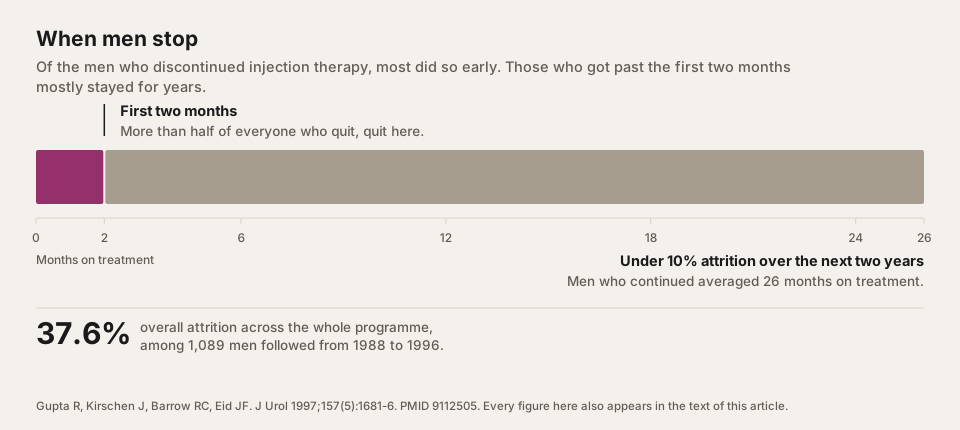
Most men who start injections eventually stop. That is not a secret and it is not an argument against the treatment, but it belongs in front of you before you start rather than after.
How many is genuinely unsettled, because it depends on how long men are followed and on what counts as stopping. In one programme of 1,089 men, overall attrition was 37.6% (Gupta et al., Journal of Urology, 1997). In a group of 294 men followed for an average of just over two years, 79.9% had stopped (Sung et al., Andrology, 2013). Different populations, measured differently, and the gap between them is the honest answer to "how many."
When men stop is far more consistent, and more useful to know. In the 1,089-man programme, more than half of everyone who quit did so within the first two months. After that the attrition rate fell below 10% across the following two years, and the men who stayed averaged 26 months on treatment. The first eight weeks are where this is decided.
Why they stop is the part worth reading slowly. Asked directly, those 294 men gave: poor response 43.1%, inconvenience 18.3%, switching to another treatment 10.7%, loss of libido 6.7%, side effects 5.5%, and spontaneous erections returning 2.8%.
The leading reason is not pain, not squeamishness about the needle, and not cost. Cost does not appear on that list at all. It is that the injections did not work well enough.
That is worth sitting with, because of how this treatment works. The dose is not prescribed once and finished. It is found, in small increments, across several attempts, and an inadequate response early on is sometimes the drug being wrong for a man and is frequently a dose that was never finished being adjusted. From the sofa on a disappointing evening those two look identical. Telling them apart is a clinical question, not a matter of trying harder.
None of which is an argument for persevering. If this is not working for you, that is a real finding and there are other options. What the numbers do say is that the early weeks are not the verdict most men take them for.
Getting it: prescription and cost
Trimix requires a prescription and is dispensed by a compounding pharmacy rather than picked up off a shelf. Because it is compounded rather than manufactured, insurance coverage is inconsistent and frequently absent. This is usually paid for directly.
Prices vary considerably by pharmacy, by concentration and by vial size, and any single figure quoted without those three attached is not information. Current ranges across the market, and how to read a per-dose cost rather than a per-vial one, are covered on the pricing page.
Where to go next
- Dosing and titration, how doses are found and adjusted, and what the units mean.
- Injection technique, sites, rotation, and doing it correctly.
- Side effects, what is normal, what is not, and what to do about each.
- Priapism and the four-hour rule, the emergency and the rescue agent.
- Storage and handling, refrigeration, beyond-use dates, travel.
- Getting a prescription, access, insurance and legality.
- Comparisons, Trimix against bimix and quadmix, against CAVERJECT and Edex, and injections against tablets.
Straight answers.
Short answers to common questions about this topic.
Sources & References
The studies and guidance this article draws on.
- 1
Predictors of success and risk factors for attrition in the use of intracavernous injection
Journal of Urology1997 - 2Andrology2013
- 3Journal of Sexual Medicine2025
- 4Cleveland Clinic Journal of Medicine2024
- 5
CAVERJECT (alprostadil) for injection, prescribing information
US Food and Drug Administration2022 - 6
Erectile Dysfunction: AUA Guideline
American Urological Association2018 - 7StatPearls2025
- 8US Food and Drug Administration2026
- 9
FDA to Telehealth Companies: What to Know When Promoting Compounded Drugs
US Food and Drug Administration2026
Contributors
Who wrote and reviewed this article.
- Written by
Caesar Editorial Team
In-house editorial teamCaesar's health library is written in-house by our editorial team rather than by a single named writer. We publish under a team byline because that is what is true: these pages are researched, drafted, checked and edited by more than one person, and a shared byline is more honest than attaching a name to work several people did. How we work. We research from primary sources: the FDA label for a drug, the published study behind a figure, the clinical guideline itself. Where a number appears on one of our pages, the sentence containing it names where it came from, so that a line lifted out of the page still carries its source. Every source is listed at the foot of the article. Where the evidence is genuinely unsettled, we say so and show the range rather than picking the most flattering figure inside it. Where we could not verify something, we leave it out and say what we could not reach. A page that gives a confident answer the evidence does not support is worse than a page that admits the limit. AI is part of how these pages are made, and we would rather tell you that than not. It assists with research and drafting. It does not choose what we cover, it does not decide what a page says, and it does not sign anything off. A person leads the work and makes the decisions, and every medical page is read by a clinician before it publishes. The reviewer's name and credentials appear on each page they have read. What this library is not. It is information, not medical advice, and reading it is not a consultation. Caesar is not your prescriber and not a pharmacy. Decisions about your treatment belong to a clinician who knows your history. If you find something on these pages that is wrong, out of date, or missing a source, we want to hear about it. Corrections are made in the open and the page records when it was last reviewed.
Author profile
Editorial & Medical Notice
Caesar publishes educational reference material. It is not a diagnosis, a prescription, or a promise of an individual result. Treatment decisions belong to you and a licensed physician who has reviewed your history and laboratory work. This review draft requires source verification and medical-director sign-off before publication.